Top Math Games for Classrooms (K–12): What Teachers Are Using Now
Classroom games have a different job than home apps. They have to work for 25 students and one screen, fit into a class period, and match the standards you're teaching this week. A game that's great at home can fall apart in a classroom.
If you're looking for math games for your classroom, the first question isn't "is it fun?" It's "will it work in my room?" Here's what to look for, and a starting list for every grade band.
What a classroom math game needs
- It works on one shared screen. Whole-class team play on a smartboard, or one Chromebook per table for stations.
- No logins. Getting 25 students signed in can eat half the period.
- It matches your standards. You should be able to tell which standards a game practices before you use it.
- It survives bad WiFi. School networks drop, filters block game sites, and testing season eats bandwidth. Offline games don't care.
- Short rounds. You need something that fits in 10 to 20 minutes, not a game that needs an hour to get going.
Every Fletcher Math game was built around that list by a middle school math teacher. Each one is a single file that plays offline, has no student accounts, and lists the standards it covers.
Kindergarten to 2nd grade
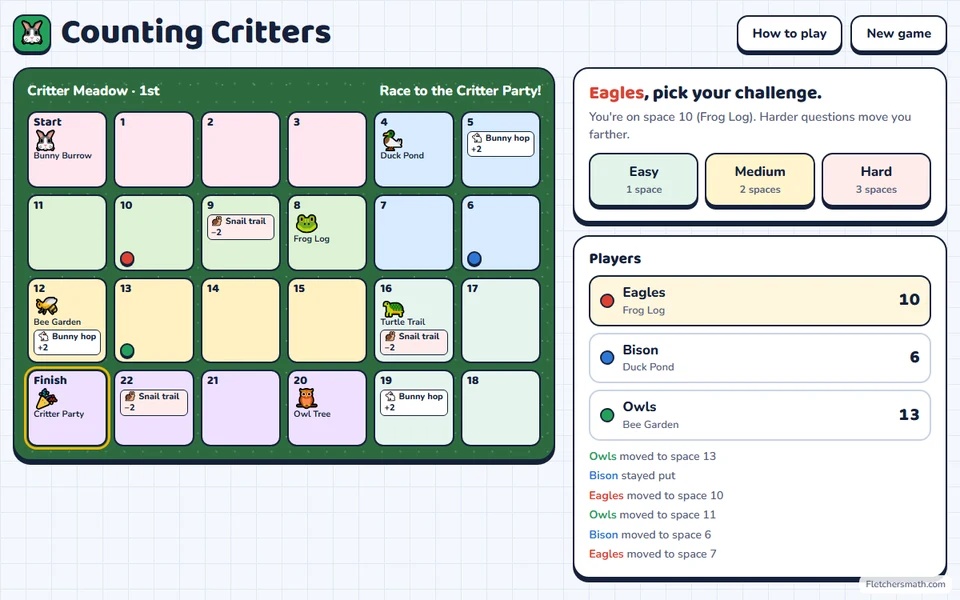
- Counting Critters: Counting, comparing, making 10, adding and subtracting.
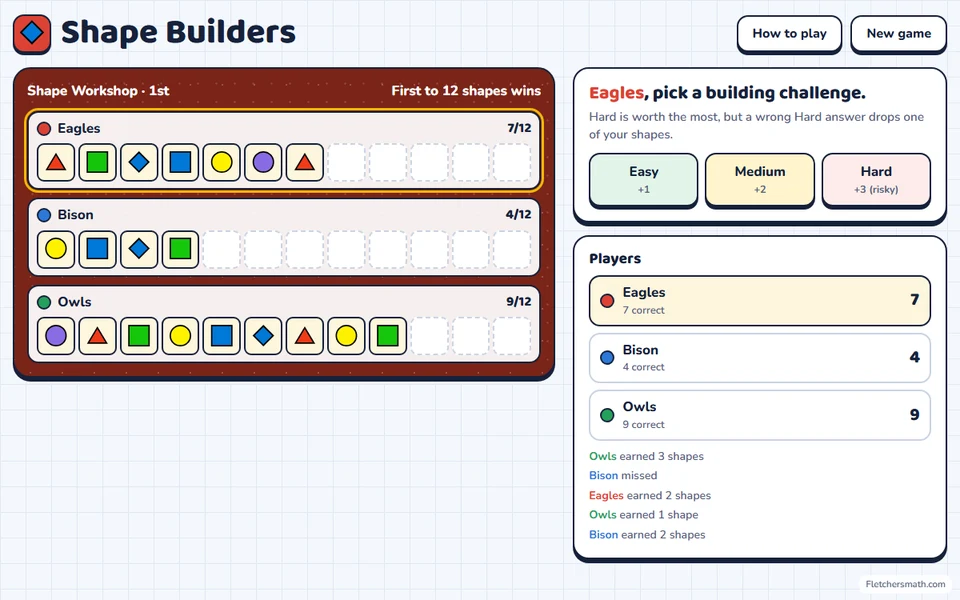
- Shape Builders: Flat and solid shapes, sides and corners, and equal parts.
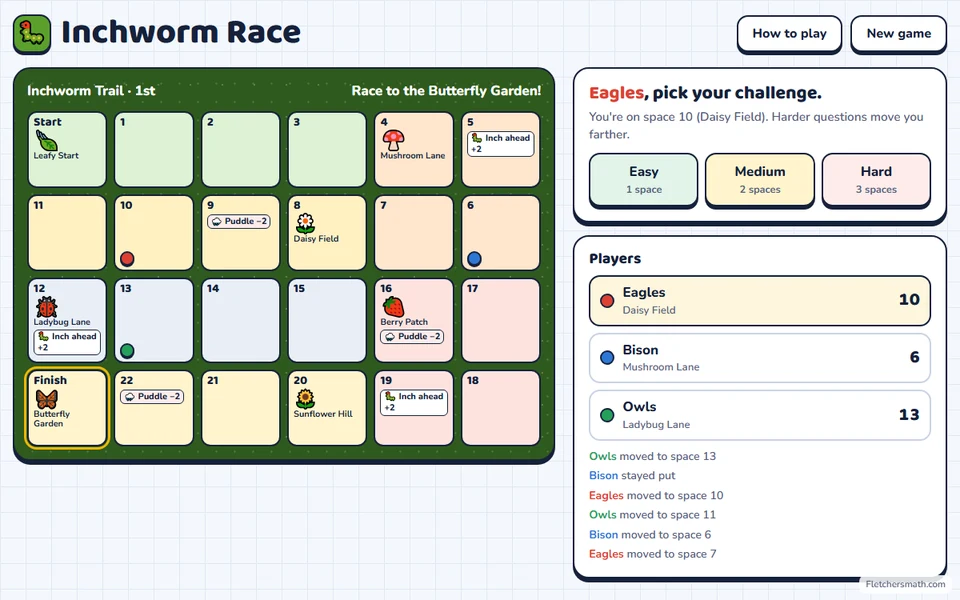
- Inchworm Race: Comparing and measuring length.
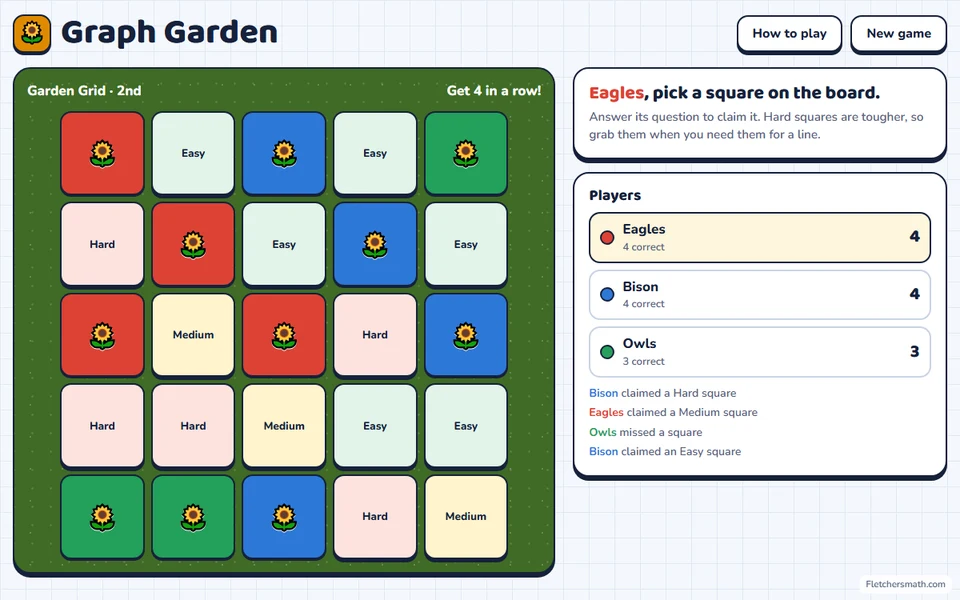
- Graph Garden: Tally charts, picture graphs and bar graphs, with a 4-in-a-row board.
More: Kindergarten, 1st grade and 2nd grade math games.
3rd to 5th grade
- Who's Multiplying?: Multiplication facts in a strategy game.
- Fraction Line Leap and Fraction Frenzy: Fractions on a number line, equivalent fractions, comparing and operations.
- Split or Stack: Multi-digit multiplication with the area model or the standard algorithm, where teams check each other's work.
- Story Problem Safari: Multi-step word problems.
- Cube Quest: Volume with unit cubes, layers and V = l × w × h.
6th to 8th grade
- Balance It!: Solving equations by keeping the scale balanced. Miss a step and the next player can steal it.
- Ratio Rummy and Percent Shopping Spree: Unit rates, proportions, discounts, tax and tips.
- Integer Expedition: Integers, rational numbers, exponents and order of operations.
- Slope Ski Run and Function Junction: Slope, intercepts and functions.
- Galaxy Race: The Pythagorean theorem, scientific notation and exponent rules.
See the full 7th grade and 8th grade lists.
High school
- Algebra 1: Solve-It Showdown, Laser Line Up, Factor Forge and Quadratic Quest.
- Geometry: If-Then Courtroom, Congruence Clash, Trig Tower and Circle Spinners.
- Algebra 2 and Precalculus: Logarithm Lodge, Polynomial Power-Up, Unit Circle Spin and Conic Constellations.
Games that span grades
Some games work across grades 3–8 because you pick the grade on the start screen and the problems change to match. These are great for review days and for teachers who have more than one grade: Math Mogul, Math Racing League, Math Escape Room, Math Detective Agency and Around the World Math.
Want to see how they fit your year? The free curriculum guide lists each unit for every grade, its standards, and the games that match.
Common questions
How many students can play at once?
Up to 6 players or teams share one screen. For a whole class, split into teams on the smartboard. For stations, put one game on each table's Chromebook.
Which standards do the games cover?
Every game lists the Common Core standards it practices, and many are also aligned to the Oklahoma Academic Standards. You can browse games by standard.
What does it cost?
Games are $5 each. The Teacher License is $150 for all 150 games plus every future game, and there are School and District licenses too.